Before you run ads, your website is the place that turns a paid click into a paying customer. Ads buy you the visit. The page has to do the rest. If the page is slow, vague, or hard to act on, you pay Google for traffic that bounces straight back. That is money spent to confirm your site does not work.
I build fast Next.js sites for small and local businesses in Greece and remotely, and I get the same call often: "I'm spending on ads but nothing's coming in." Almost every time, the ad is fine. The page it points to is the leak. Here is what the page needs first, so the ad money has somewhere to land.
Why does running ads to a weak website waste money?
Running ads to a weak website wastes money because you pay for every click whether or not the page converts. Google charges you the moment someone clicks, not when they buy. So a page that loads slow, hides the offer, or buries the phone number burns your budget on visitors who leave in seconds. Fixing the page first means the same ad spend brings more calls, not more bounces.
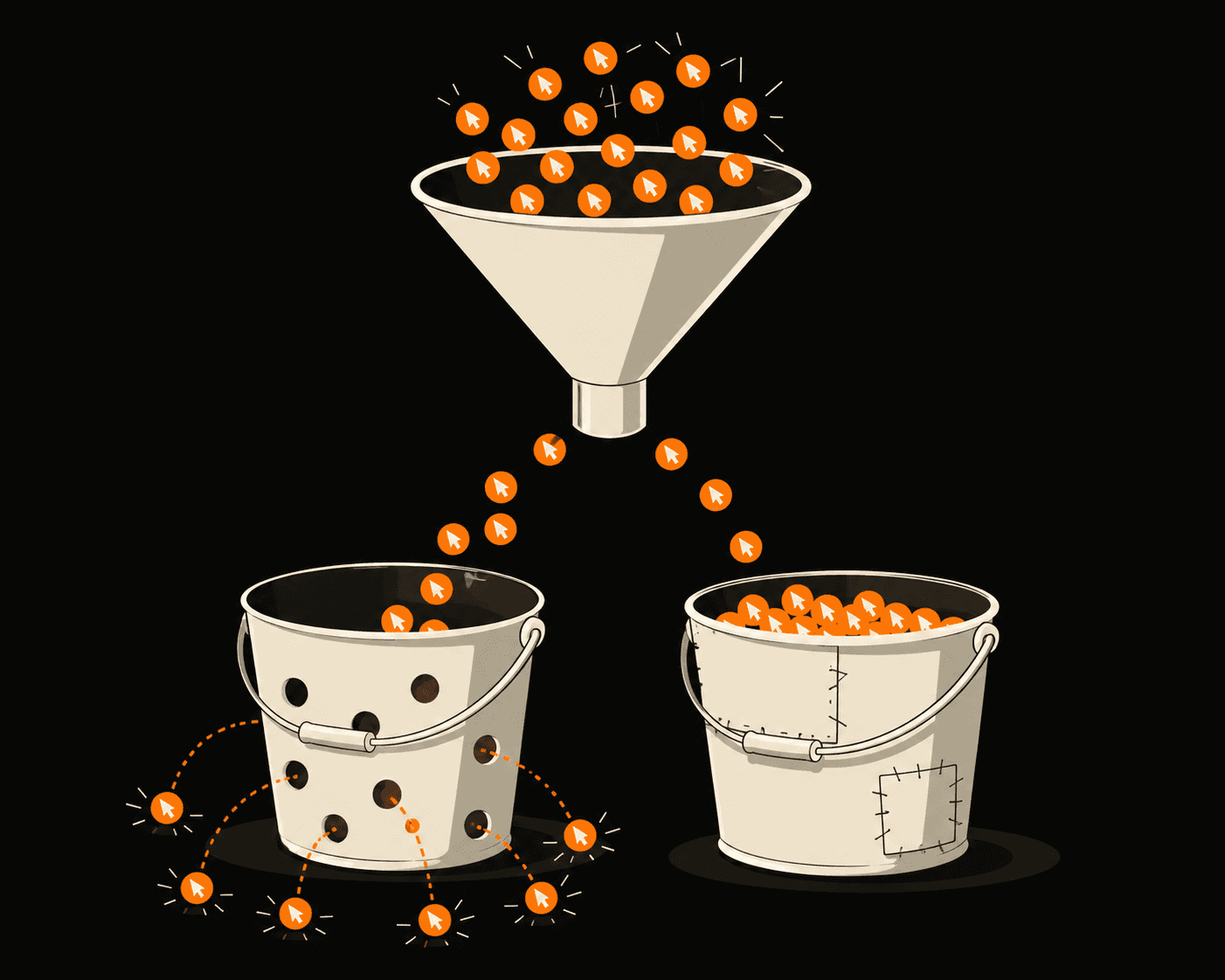
Think of it as a leaky bucket. Ads pour water in at the top. If the page has holes, most of it runs out before you collect a drop. Pouring faster (a bigger ad budget) does not fix a bucket with holes. You patch the holes first, then you scale the spend. Every euro you put behind a broken page just finds the leak faster.
What does a website need before you run ads?
A website needs to load fast, match the ad, state the offer clearly, prove you are real, make one action obvious, and track what happens. Miss any of those and the ad pays for visits you cannot convert or measure. Below are the six I check before I let a client spend a cent on traffic.
A dedicated landing page
Do not send paid traffic to your homepage. A homepage talks to everyone, which means it talks to no one. Build one page for the one thing the ad promises. If the ad sells emergency plumbing, the page is about emergency plumbing, with the phone number at the top. One page, one job, one action. You can see how I keep pages focused in my recent work.
Message match
The page has to repeat the ad's promise in its first line. If your ad says "Free roof inspection in Xanthi," the page headline says the same thing, not "Welcome to our company." When the words on the page match the words that earned the click, people relax and read on. When they do not match, the visitor thinks they landed in the wrong place and leaves. That gap is one of the quietest ways to waste ad spend.
A clear offer
Say exactly what someone gets, for whom, and what it costs or how to start. "Quality service you can trust" tells a visitor nothing. "Same-day boiler repair, fixed price, no call-out fee" tells them everything. Vague offers make people hesitate, and hesitation on a paid visit is money gone. Write the offer so a stranger understands it in one read.
Proof you are real
People do not buy from a page that could be anyone. Add real reviews, a photo of you or your team, the town you serve, and a phone number that works. Two or three genuine testimonials beat a paragraph of adjectives. Trust is not something you claim on the page. It is proof you put on the page.
One strong call to action
Decide the single thing you want the visitor to do, then make it obvious and repeat it. "Call for a free quote." "Book a 15-minute call." "Message me on WhatsApp." Put it at the top, the middle, and the bottom, so nobody has to scroll back to act. A confused visitor does nothing, and on paid traffic, nothing is expensive.
Tracking that works
You cannot improve what you cannot see. Install conversion tracking before the first ad goes live, so you know which clicks become calls and forms, not just visits. Google's own guidance is blunt: conversion tracking is the foundation for measuring whether your ads actually drive results (support.google.com). Without it, you are guessing with your own money.
How fast does the page need to load before ads?
The page should load and become usable in about two seconds on a phone, because most paid clicks come from mobile and slow pages lose people before they read a word. If your landing page takes five or six seconds, a large share of the traffic you paid for is gone before the offer even appears. You are buying clicks that never see your headline.
I build mobile-first and watch Core Web Vitals so the page is fast on a real phone on real data, not just on my laptop. Speed is not a technical nicety here. On paid traffic it is the difference between a click that converts and a click you threw away. Test your own page on your phone, on mobile data, before you spend.
Fix the page first, then turn on the ads
Ads do not fix a weak website. They expose it faster and bill you for the privilege. Get the page right first: fast, matched to the ad, one clear offer, real proof, one obvious action, and tracking that tells you what worked. Then the same budget brings more customers instead of more bounces.
If you are about to run ads and you are not sure your page is ready, tell me about it and I'll check it before you spend. If you want a clean, fast starting point, you can also begin from one of my ready-made templates.