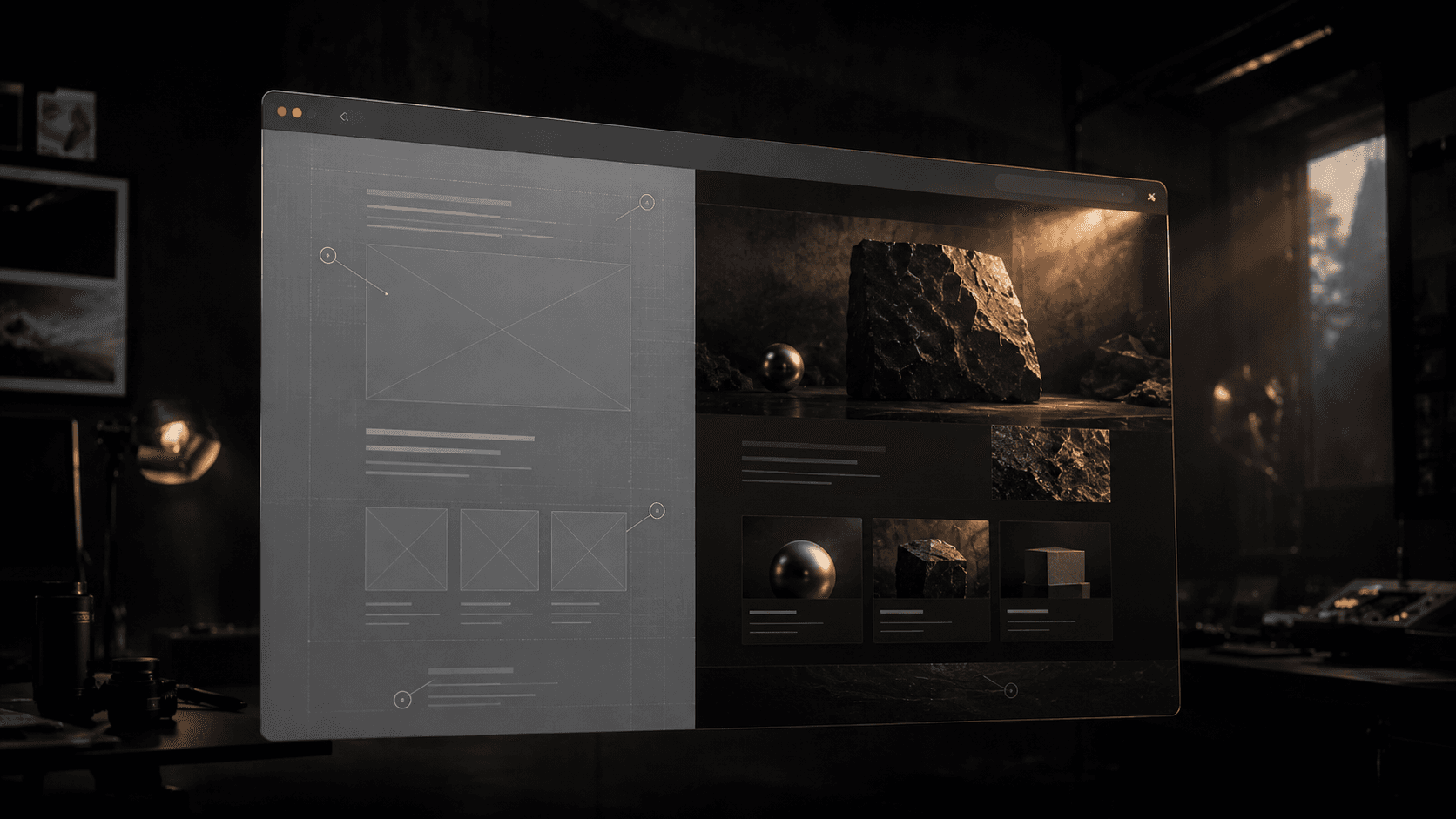
In film FX, nothing reaches the screen on one person's say-so. A shot gets looked at by people whose entire job is to find what's wrong with it: the edge that flickers, the shadow falling the wrong way, the one frame that breaks the illusion. You stop taking it personally after a while. The review is the work.
Then I started building websites and realised almost nobody works like that. Most sites get eyeballed once by the person who made them, pushed live, and that's the end of it. They look fine in the one browser the designer happened to have open. They're decoration. And six months later the owner can't change a single sentence without emailing someone and waiting three days for the privilege.
I didn't want to make those. So I built my own way of working, and that process is what you're actually hiring when you come to KlawsFX.
A website is a product, not a picture
Here's the part most people selling you a "website" quietly skip. The site you look at is the easy 30%. The other 70% is everything that decides whether it earns its keep: whether it loads fast, whether it can be found, whether it stays standing under a traffic spike, whether you can run it yourself, whether someone can break into it.
Every site I ship has that 70% already handled. Proper search setup, not the bolted-on kind. A real content system, so every word on the page belongs to you and is yours to change. Logins and forms built the right way, with the protections that stop your contact form turning into someone's spam cannon. Speed treated as a feature, because a slow page is just a page people leave. None of that is an upsell on my invoices. It's the floor.
I build sites to be quoted by AI, not only ranked by Google
This is the one I'd pay attention to if I were you.
The way people find things is splitting in two. Half still type into Google. The other half just ask ChatGPT, or Perplexity, or whatever assistant their phone now ships with, and they take the answer they're handed. That answer gets assembled from a small number of sources the model decided to trust. If your business isn't written in a way those models can lift cleanly, you don't exist to that entire half of the market, and it's the half that's growing.
There's a name for building so you land in those answers (it's called Generative Engine Optimisation, if you want to go read about it). It's newer than ordinary search optimisation and most web shops still aren't doing it. I bake it into every build by default: the structure, the phrasing, and the machine-readable layer the assistants actually read. I'd rather your next customer hear your name from the assistant they already trust than cross their fingers and hope they scroll far enough down a results page.
You run it, not a support ticket
When I hand a site over, I hand you the keys.
The back office is built for a normal person, not a developer. Write a new article or add a product, and as you type, it quietly coaches you: this headline's weak, this needs a clearer opening line, here's the bit that helps you get found, you forgot to describe that image. You see the suggestions, take the ones you agree with, ignore the rest, and publish something that's already tuned before it goes out. No middleman. No waiting on me to fix a typo or change a price.
There's a mailing list built in too, and it already knows your site. Your content is organised into categories, and those same categories are who you send email to, so "message everyone interested in X" is two clicks instead of a spreadsheet and a prayer.
It won't look like it fell out of a machine
You know the look by now. The purple gradient. The three identical cards in a row. The same hero section every one-click builder spits out. I use serious tooling to move fast, I'd be lying if I pretended otherwise, but speed is worthless if the result looks like everyone else's. So the final thing every site passes through is a hard design review whose only job is to catch the generic and the templated, the "I've seen this exact layout a hundred times." If it reads as machine-made, it doesn't go out. Same standard for the unglamorous checks: actually opened in real browsers at phone, tablet and desktop sizes, tested for accessibility, scanned for security holes. Not "looked fine on my screen." Checked.
The marketing fits where it lands
When a site launches I can hand you a set of launch posts made for each platform, not one message copy-pasted across five of them. What works on LinkedIn dies on TikTok. You get the version built for each one, in your voice.
Who this is for
I'm not the cheapest option on the comparison table and I'm not trying to be. If all you want is the lowest possible number and you don't mind a site that looks like the four next to it, there are faster and cheaper tools out there, and I'll happily point you at them.
But if you want something that's findable in 2026, that you can run without me, that holds up when it's poked at, and that doesn't look like it came off a template, that's the entire reason KlawsFX exists.
How I build it is mine. What you get out of it is the part that's yours.